Aged Care Reform: The Compliance Burden We Were Warning About Years Ago
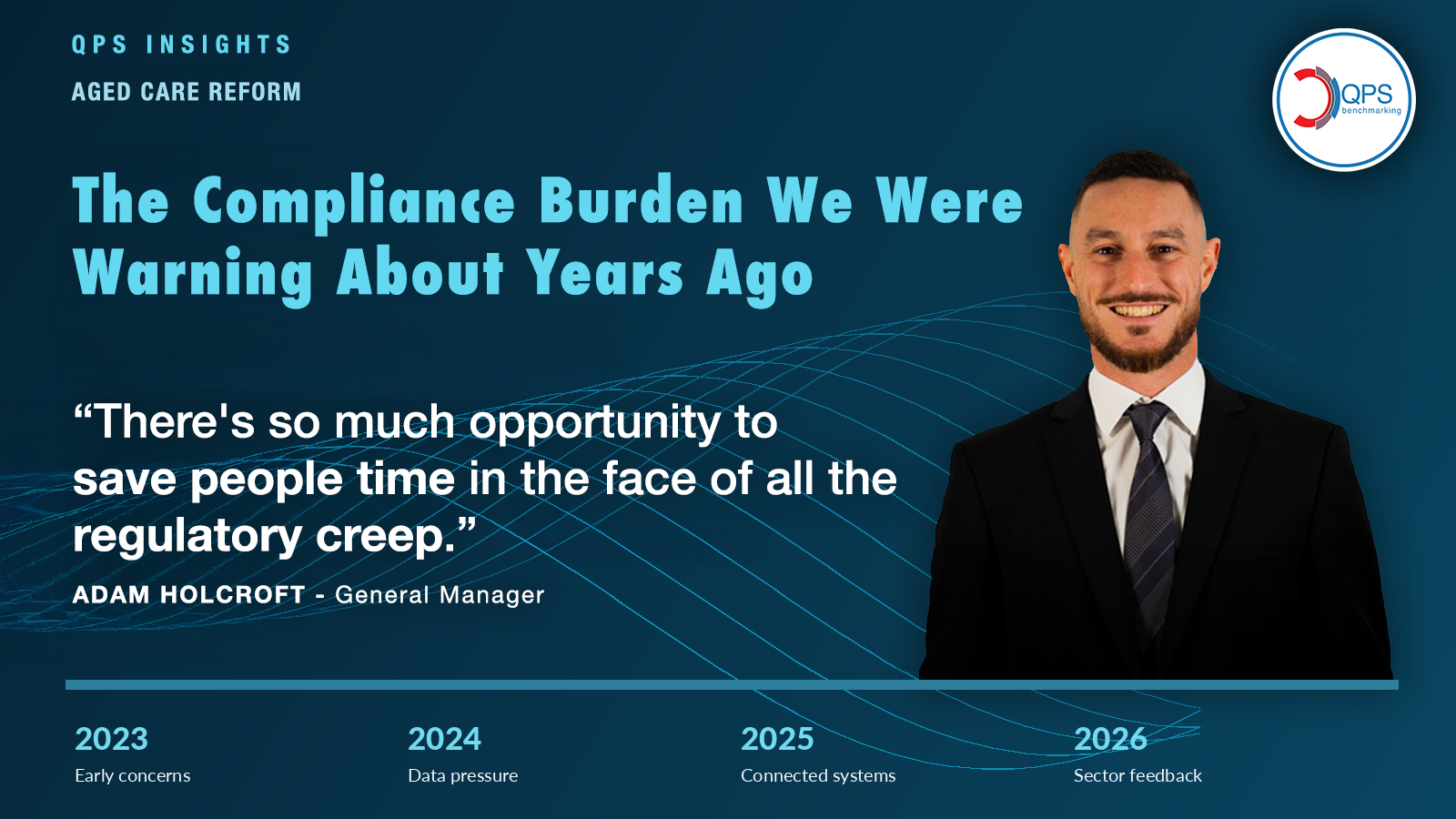
As aged care leaders describe the growing administrative pressures of reform, QPS Benchmarking revisits concerns raised publicly since 2023 — and asks whether more reporting is translating into better care.
By Adam Holcroft | General Manager, QPS Benchmarking
As Australia enters its second year under the new Aged Care Act, aged care executives are describing familiar challenges: increasing administrative workloads, complicated reporting processes and the difficulty of putting major reforms into practice while continuing to deliver care.
These concerns are not new. At QPS Benchmarking, we have been discussing the growing demands of quality reporting, the risk of unnecessary double handling and the importance of turning information into meaningful action for years.
The issue has never been whether providers should be accountable. Of course they should. The question is whether the systems supporting that accountability are helping people deliver better care — or making the job unnecessarily difficult.
A conversation that started well before the new Act
In June 2023, in How admin efficiency affords more one-to-one care time, I spoke about the delicate balance between compliance obligations, financial sustainability and the care minutes residents need. I also described how the sector had shifted from a focus on excellence towards a greater emphasis on compliance.
In October 2023, Does aged care data collection require some pause and reflection? examined the expanded National Quality Indicator Program. I raised concerns about survey fatigue and the extra work involved in collecting information, while emphasising that measuring a problem is only useful if organisations can take corrective action.
The Winter 2024 edition of Aged Care Today took that conversation further. In Navigating the evolving data landscape (page 92), QPS highlighted how escalating reporting requirements could complicate data management and consume time needed for resident care. The piece also emphasised the importance of accurate, validated data for sound operational decisions and governance.
By September 2025, with the new Act approaching, I was discussing regulatory creep and the role of connected systems in Navigating compliance effectively. The opportunity was not simply to collect information faster, but to reduce needless administrative activity through integration, automation and a practical continuous improvement process.
“There's so much opportunity to save people time in the face of all the regulatory creep.”
— Adam Holcroft, Hello Leaders, September 2025
Most recently, an August 2026 Hello Leaders interview revisited the growing cost of reporting, the demands of resident-level data scrutiny and the need for useful feedback on the information providers submit.
These were not predictions of every individual reform. They were expressions of the same underlying concern: when reporting obligations expand without better processes for managing information, the burden falls on the people responsible for care.
What sector leaders are describing today
On 19 October 2026, The Ageing Agenda reported the experiences of senior aged care executives implementing the new Act. Their accounts make clear that the practical workload of reform is a major issue.
Whiddon described employing additional staff to manage administrative demands associated with implementation, while working to reduce duplication wherever possible. Anglicare Southern Queensland detailed changes to intake processes, communications, governance and quality assurance. Warrigal spoke about the challenge of translating reform objectives into everyday practice.
Different organisations face different operational pressures. But a common question emerges: how can providers meet higher expectations without continually adding administrative work?
Collecting information is not the same as improving quality
Aged care providers collect extensive information through assessments, quality indicators, audits, incidents, complaints, consumer experience surveys and operational reporting. Much of that information is essential to understanding performance and protecting the people in their care.
But consider what happens when these activities operate independently. A clinical system records an incident. An audit identifies a related concern. A spreadsheet tracks corrective actions. Another system produces a management report. Each step may be valid, but disconnected information can create duplication, delays and additional opportunities for error.
It can also become harder to establish whether an issue was properly addressed. An organisation may have excellent records of what happened but a less complete picture of what changed as a result.
The value of quality data comes from the decisions, actions and improvements it supports — not simply from the volume collected.
Three opportunities for more connected quality management
1. Reduce duplicated data entry
Where relevant information already exists in clinical or operational systems, providers should examine whether it can support quality reporting without repeated manual entry. Appropriate integrations and validation processes can reduce double handling while protecting the reliability of the underlying information.
2. Connect findings directly to action
An audit finding, incident or concerning result should lead to a clear process for investigation, assignment, follow-up and review. Digital auditing and continuous quality improvement systems can help keep this process visible and consistent, so issues are managed rather than simply recorded.
3. Turn reporting into useful insight
Managers and governing bodies need more than large volumes of performance information. They need to understand emerging risks, meaningful trends, the evidence behind reported figures and whether improvement activities are having the intended effect. Benchmarking and connected reporting help make that possible.
How QPS has responded
At QPS Benchmarking, we have increasingly focused our development on making quality information easier to collect, verify, understand and act upon.
- Our National Quality Indicator Application supports structured data collection, validation and reporting.
- Our Digital Auditing System helps replace paper and spreadsheets, with non-compliant audit findings able to feed into improvement actions.
- Converge CQI connects quality issues with responsible staff, actions, follow-up and outcomes.
- Our benchmarking and management reporting capabilities support performance comparisons, trend analysis and executive oversight.
- Our data automation and integration work connects relevant information from existing clinical and operational platforms where technically feasible and appropriately authorised.
We do not believe providers should have to replace effective clinical systems simply to improve their quality oversight. The objective is to make appropriate information flow more effectively between the systems they already use.
A better question for the second year of reform
Technology cannot resolve every challenge facing aged care. Funding, workforce capacity and government reporting policy require solutions beyond any individual provider's software. But organisations can still examine how efficiently their own quality information moves through the business.
- Are staff entering the same information in more than one place?
- Can managers readily see which quality issues are unresolved?
- Are audit findings connected to documented actions and outcomes?
- Can executives explain the evidence behind the results presented to governing bodies?
- Is the effort devoted to data collection producing meaningful improvements for the people receiving care?
We have been asking variations of these questions since 2023. As the sector enters its second year under the new Act, they deserve practical answers.
Better compliance processes should support better care — not compete with the time needed to provide it.
Make your quality information work harder, not your staff
Discover how QPS Benchmarking can help streamline auditing, reporting, benchmarking and continuous quality improvement. Book a QPS Benchmarking webinar to discuss your organisation's existing systems and opportunities to reduce unnecessary administrative work.
0 comments